
Cardiovascular System Diseases Treatment and Prevention
Understanding the therapeutic basics of the cardiovascular system and the
medications used to manage it is an essential step in preparing for your role
as a
Pharmaceutical Sales Representative. This content provides a clear introduction to how Cardiovascular System
Diseases Treatment and Prevention are approached through different drug
classes and therapeutic mechanisms.

For anyone aiming to build a strong career in pharmaceutical sales, this
knowledge will not only help you communicate medical information effectively
with healthcare providers but also give you practical insights that are
crucial for training and real-world fieldwork.
Table of contents: Cardiovascular System Diseases Treatment and Prevention
Check out the table of contents of this article and you can click on the part
you want to read from-
- Cardiovascular System Diseases Treatment and Prevention
- Classification chart of Cardiovascular System Drugs
- Therapeutic Basics of Cardiovascular System Generic Drugs
- Therapeutic Basics of Cardiovascular System
- Difference: ACE Inhibitor & AT1 Receptor Blocker
- Difference: Non Selective & Cardioselective Beta- Blocker
- Drugs: Congestive Heart Failure
- Diagnostic Tests for Cardiovascular System Diseases
- FAQs
- Conclusion
Cardiovascular System Diseases Treatment and Prevention
First, I’ll go over the diseases of the cardiovascular system, and then I’ll
move on to their treatment and prevention.
Cardiovascular System Diseases
Anemia: Anemia is a reduction of hemoglobin concentration per unit of
peripheral blood. As a result, Oxygen carrying capacity of blood is
decreased.
Aplastic Anemia: Anemia which is due bone marrow depletion, is called Aplastic
anemia.

Leukemia: It is a disease due to abnormal increase in WBC.

Endocarditis: Inflammation of Endocardium is called Endocarditis
Atherosclerosis: Atherosclerosis is a disease in which the inside of an artery
narrows due to the buildup of plaque.

Ischemic Heart Disease: Coronary artery disease (CAD), also known as Coronary heart disease
(CHD), ischemic heart disease (IHD) or simply heart disease, involves the
reduction of blood flow to the heart muscle due to build-up of plaque
(atherosclerosis) in the arteries of the heart. It is the most common of
the cardiovascular diseases.

Myocardial Infarction: A heart attack occurs when one of the heart's coronary arteries is
blocked suddenly or has extremely slow blood flow. A heart attack also is
called a myocardial infarction.

Angina pectoris: Angina pectoris is the medical term for chest pain or discomfort
due to coronary heart disease.

Arrhythmia: Arrhythmia, also known as cardiac arrhythmia or heart arrhythmia,
is a group of conditions in which the heartbeat is irregular, too fast, or
too slow.
Hypertension: Hypertension is a condition in which the blood
pressure in the arteries is persistently elevated.
Heart Failure: Heart failure is a condition in which the heart is
unable to pump blood effectively to meet the needs of the body.
Cardiomyopathy: Cardiomyopathy is a disease of the heart muscle
that makes it harder for the heart to pump blood to the rest of the body.
Valvular Heart Disease: Valvular heart disease occurs when one or
more of the heart’s valves do not function properly, causing disturbed
blood flow inside the heart.
Pericarditis: Pericarditis is an inflammation of the pericardium,
the thin sac-like membrane surrounding the heart.
Deep Vein Thrombosis (DVT): DVT is a condition in which a blood
clot forms in a deep vein, usually in the legs.
Pulmonary Embolism (PE): Pulmonary embolism is a blockage in one of
the pulmonary arteries in the lungs, usually caused by blood clots
traveling from the legs.
Stroke (Cerebrovascular Accident): Stroke occurs when the blood
supply to a part of the brain is interrupted or reduced, preventing brain
tissue from getting oxygen and nutrients. Stroke is often included in
cardiovascular diseases because it results from blockage or rupture of
blood vessels, linking it directly to the vascular system.
Cardiovascular System Treatment and Prevention
Cardiovascular diseases are among the leading causes of death and serious
complications worldwide, and for that reason both treatment and prevention
need to be given equal importance. The choice of treatment largely depends
on the type of disease and its severity, while preventive measures are
relevant to everyone in order to reduce the overall risk.
Cardiovascular System Treatment
The treatment of cardiovascular diseases can be broadly divided into four
main approaches.
First, pharmacological therapy: To control blood pressure,
medications such as ACE inhibitors, ARBs, beta-blockers, calcium channel
blockers, and diuretics are commonly prescribed. To prevent blood clot
formation, antiplatelet and anticoagulant drugs are used, including
Aspirin, Clopidogrel, Warfarin, and newer
NOACs. For cholesterol management, Statins, Ezetimibe, and
PCSK9 inhibitors
are widely recommended.
In patients with heart failure, therapy may include diuretics,
beta-blockers, ACE inhibitors or ARBs, and aldosterone antagonists. For
arrhythmias, antiarrhythmic drugs such as Amiodarone or Digoxin are used
to maintain rhythm control.
Second, interventional therapy: The most common procedures are
Angioplasty and Stenting, which restore blood flow by opening blocked coronary arteries.
Catheter-based procedures are also applied in cases of valvular or
congenital heart diseases.
Third, surgical therapy: Coronary Artery Bypass Graft (CABG)
surgery is one of the most established treatments, where a new route is
created around blocked arteries. Damaged heart valves may be repaired or
replaced, and in advanced stages of heart failure, a heart transplant can
be considered.
Fourth, supportive care: This includes oxygen therapy, cardiac
rehabilitation programs, lifestyle counseling, and the use of medical
devices such as Pacemakers or Implantable Cardioverter Defibrillators
(ICDs).
Cardiovascular System Prevention
Prevention of cardiovascular diseases is generally approached in three
ways.
First, primary prevention: This is aimed at people who have not yet
developed any heart disease. Key measures include maintaining a healthy
diet (low salt, low fat, high in fruits and vegetables), regular physical
activity, weight management, and avoidance of smoking and excessive
alcohol consumption. Stress management and adequate sleep are also vital.
In certain cases, vaccines such as influenza and pneumonia vaccines may
help reduce complications in people at risk.
Second, secondary prevention: This applies to patients who already
have cardiovascular disease. It includes adhering to prescribed
medications such as Antiplatelets, Statins, and Blood pressure
medications. Participation in cardiac rehabilitation programs and regular
follow-up with healthcare providers are also essential.
Third, risk factor control: Conditions like diabetes, hypertension,
and dyslipidemia need to be managed consistently, as they significantly
increase cardiovascular risk. Quitting smoking and maintaining a healthy
lifestyle remain the most effective strategies.
Finally, regular health check-ups: Monitoring blood pressure, blood
sugar, and lipid profiles is important for early detection and management.
Individuals with a family history of heart disease should be especially
careful and proactive in screening.
Classification chart of Cardiovascular System Drugs
Classification chart:
| Sl. No | Sub Class | Therapeutic Group |
|---|---|---|
| 1 | Antihypertensive |
a) Angiotensin II Receptor Blockers (ARB) b) Calcium Channel Blocker (CCB) c) Beta Receptor Blocker d) Diuretic e) Angiotensin Converting Enzyme (ACE) Inhibitors |
| 2 | Antianginal | a) Nitrates b) Fatty Acid Oxidation Inhibitor |
| 3 | Lipid Lowering |
a) HMG CoA Reductase Inhibitors (Statins) b) Fibrates |
| 4 | (Not Specified) | a) NSAID b) Antiplatelet (Antithrombotic) |
Therapeutic Basics of Cardiovascular System Generic Drugs
Here is a list of generic drugs commonly prescribed for the management
of different cardiovascular system diseases.
Sub Class: Antihypertensive Generic Drugs Name
Purpose: Control blood pressure and reduce risk of stroke, heart
failure, and kidney damage.
| Therapeutic Group | Generic Name | Training Note |
|---|---|---|
| ARB | Losartan Potassium, Olmesartan Medoxomil, Telmisartan | Blocks angiotensin II, relaxes blood vessels |
| ARB (Combinations) | Losartan + Hydrochlorothiazide, Olmesartan + HCTZ, Olmesartan + Amlodipine, Telmisartan + Amlodipine | Dual therapy for better BP control |
| ACE Inhibitors | Enalapril, Lisinopril, Ramipril, Perindopril, Captopril | Lowers BP, protects heart & kidneys |
| CCB | Amlodipine, Cilnidipine, Levamlodipine | Relaxes arteries, reduces vascular resistance |
| Beta Blocker | Atenolol, Bisoprolol Hemifumarate, Nebivolol | Slows heart rate, reduces cardiac workload |
| Beta Blocker + Diuretic | Bisoprolol + Hydrochlorothiazide | Combination for resistant hypertension |
| CCB + Beta Blocker | Amlodipine + Atenolol, Amlodipine + Bisoprolol, Bisoprolol + Amlodipine | Dual action to control BP and heart rate |
| Diuretic | Spironolactone + Furosemide, Indapamide | Removes excess salt & fluid, lowers BP |
Sub Class: Antianginal Generic Drugs Name
Purpose: Improve oxygen supply to the heart and reduce chest pain
(angina).
| Therapeutic Group | Generic Name | Training Note |
|---|---|---|
| Beta-blockers | Propranolol (non-cardioselective), Atenolol, Bisoprolol (cardioselective) | Reduce heart rate and myocardial oxygen demand |
| Nitrates (Vasodilators) | Nitroglycerin, Isosorbide Mononitrate, Isosorbide Dinitrate | Dilate blood vessels, improve blood flow, relieve chest pain |
| Calcium Channel Blockers (CCB) | Amlodipine, Nifedipine | Relax coronary arteries, improve oxygen supply |
| Fatty Acid Oxidation Inhibitor | Trimetazidine HCl | Enhances energy metabolism in heart cells |
| Other Vasodilators | Nicorandil | Improves coronary blood flow, relieves angina |
| Antiplatelet Agents | Aspirin (Salicylic acid) | Prevents platelet aggregation, reduces risk of heart attack and stroke |
Sub Class: Lipid Lowering Generic Drugs Name
Purpose: Reduce cholesterol and triglycerides, prevent
atherosclerosis and heart attack.
| Therapeutic Group | Generic Name | Training Note |
|---|---|---|
| Statins (HMG-CoA Inhibitors) | Atorvastatin, Rosuvastatin, Atorvastatin + Ezetimibe | Lowers LDL, proven CV risk reduction |
| Fibrates | Fenofibrate | Mainly lowers triglycerides |
| Other Lipid-Modulating Agents | Vericiguat (for HFpEF patients) | Newer drug for heart failure with preserved EF |
Sub Class: Antiplatelet / Antithrombotic / Blood Thinner Generic Drugs Name
Purpose: Prevent clot formation, reduce risk of stroke and
myocardial infarction.
| Therapeutic Group | Generic Name | Training Note |
|---|---|---|
| NSAID | Aspirin | Irreversibly inhibits platelet aggregation |
| Antiplatelet (Advanced) | Clopidogrel, Ticagrelor, Prasugrel | Prevent clotting, especially after stent placement |
| Combination | Aspirin + Clopidogrel | Dual antiplatelet therapy for higher protection |
Therapeutic Basics of Cardiovascular System
The therapeutic basics of the cardiovascular system and its medications
explain how different drug classes help manage heart conditions such as
hypertension, arrhythmia, and heart failure. As a Pharmaceutical Sales
Representative, it is important to understand how these treatments work in
order to explain them clearly to healthcare providers.
This knowledge provides the foundation for effective medical
communication, while also highlighting the essential role of
Cardiovascular System Diseases Treatment and Prevention in modern patient
care. By mastering these concepts, you strengthen both your expertise and
your ability to add value in the field.
What is
the cardiovascular system
and why is it important?
The cardiovascular system includes the heart and blood vessels. It
delivers oxygen and nutrients to the body and removes waste products. Its
proper function is vital for life.
What are the common cardiovascular diseases (CVDs)?
The most common CVDs include hypertension, heart failure, angina,
myocardial infarction (heart attack), and
arrhythmias.
What is Blood Pressure?
It is the lateral pressure exerted on the wall of the blood vessel by
the flowing blood.

Blood pressure is the force of blood pushing against the walls of
arteries as it flows through them.

Blood Flow in the Heart

Blood Flow in the Heart: Our body needs oxygen to stay
alive. The heart is the organ that pumps oxygen-rich blood to every
part of the body. It also brings back oxygen-poor blood to send it to
the lungs for fresh oxygen. Let’s understand this step by step.
1. Oxygen-poor blood returns from the body to the heart
After delivering oxygen to different parts of the body, blood becomes
oxygen-poor. This blood returns to the heart through two large veins:
- From the upper body: Superior Vena Cava
- From the lower body: Inferior Vena Cava
This blood enters the
Right Atrium
(upper right chamber of the heart).
2. Blood goes to the lungs for oxygen
From the Right Atrium, the blood flows into the
Right Ventricle
(lower right chamber).
The Right Ventricle then pumps the blood to the lungs through the
Pulmonary Artery.
In the lungs, the blood picks up fresh oxygen and releases carbon
dioxide.
3. Oxygen-rich blood comes back to the heart
The oxygen-rich blood returns from the lungs to the heart through the
Pulmonary Veins.
It enters the
Left Atrium
(upper left chamber).
4. Oxygen-rich blood is pumped to the whole body
From the Left Atrium, blood flows into the
Left Ventricle
(lower left chamber).
The Left Ventricle is the strongest part of the heart. It pumps the
blood into the
Aorta, the largest artery, which carries the oxygen-rich blood to the
entire body.
Quick Summary of the Blood Flow Path:
Body → Right Atrium → Right Ventricle → Lungs → Left Atrium → Left
Ventricle → Body
Important Valves in the Heart
The heart has four main valves that keep the blood moving in the
right direction:
- Tricuspid Valve: Between Right Atrium and Right Ventricle
- Pulmonary Valve: Between Right Ventricle and Pulmonary Artery
- Mitral Valve: Between Left Atrium and Left Ventricle
- Aortic Valve: Between Left Ventricle and Aorta
Final Words: The heart works like a smart pump that keeps blood
moving, delivering oxygen and removing waste. This continuous blood
flow is what keeps us alive every second.

Quick Summary:
- Right side of the heart: Handles oxygen-poor blood and sends it to the lungs.
- Left side of the heart: Handles oxygen-rich blood and sends it to the body.

Cardiac Output
It is the amount of blood discharged by the left ventricles into the
aorta per minute.

It depends on:
- Blood Volume
- Venous Return
- Force of Contraction of Myocardium or Inotropic property
- Frequency of heart beat
Peripheral Vascular Resistance
It is the resistance offered by the blood vessel to the
circulating blood.

It depends on:
- Elasticity of Arterial Wall
- State of lumen of Blood Vessel
- Velocity of Blood
- Viscosity of Blood
Blood Pressure: Controlling Factors
Blood Pressure = Cardiac Output X Peripheral Vascular
Resistance.
- BP = CO X PVR
- BP = Blood Pressure
- CO = Cardiac Output
- PVR = Peripheral Vascular Resistance
BP can be increased or decreased depending on CO and PVR
change.
Regulation of Blood Pressure Mechanisms
There are three main mechanisms involved in the regulation of Blood
Pressure.
They are:
- Nervous Mechanism
- Renin Angiotensin Aldosterone System (RAAS)
- Calcium Influx Mechanism
1) Nervous Mechanism
Sympathetic and parasympathetic nervous both can influence BP.
Sympathetic nervous system secretes hormones Epinephrine and
Norepinephrine.

They have:
- Vasoconstricting Effect
- Myocardial Contractility
- Heart Rate
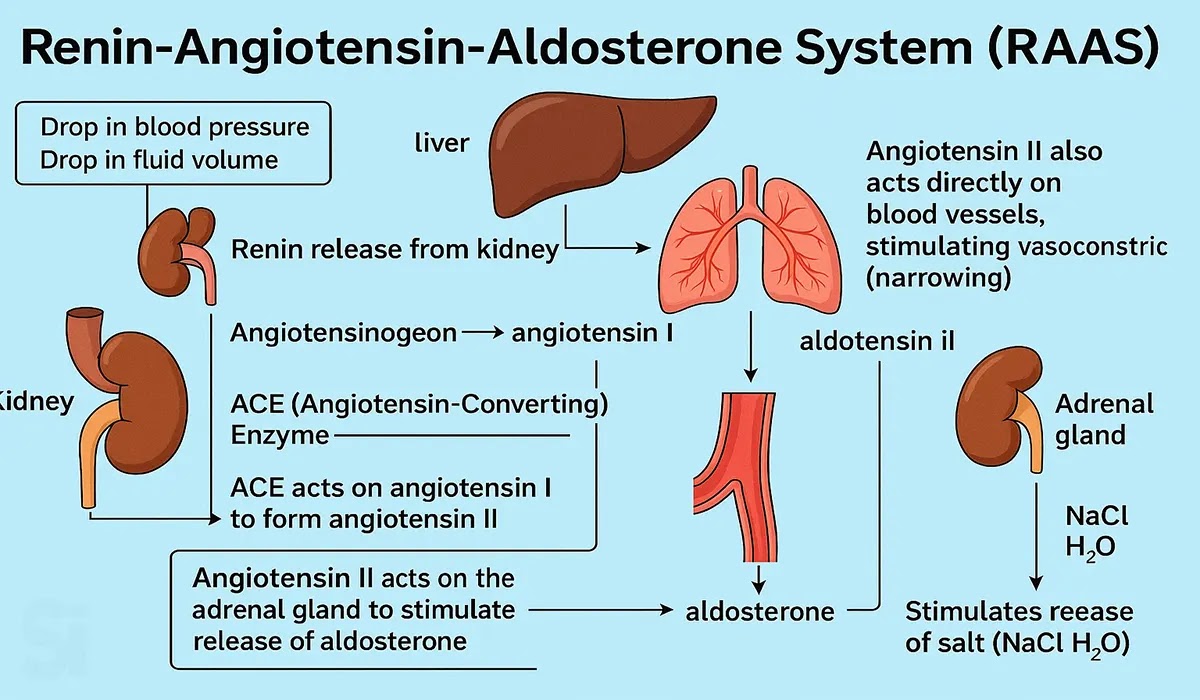
2) Renin Angiotensin Aldosterone System (RAAS)
The RAAS is a hormone system that helps regulate blood pressure
and fluid balance in the body.

Step-by-Step Explanation:
Step A: Drop in Blood Pressure or Blood Volume
- When there is a decrease in blood pressure or low fluid volume, the kidneys detect this change.
- In response, the kidneys release a hormone called Renin.
Step B: Renin Converts
Angiotensinogen
into Angiotensin I
- The liver continuously produces a protein called Angiotensinogen.
- Renin acts on angiotensinogen and converts it into Angiotensin I.
Step C: Angiotensin I is Converted to
Angiotensin II
- In the lungs, an enzyme called ACE (Angiotensin-Converting Enzyme) is released.
- ACE converts Angiotensin I into Angiotensin II, which is the active form.
Step D: Actions of Angiotensin II
Angiotensin II has two main effects:
- It causes vasoconstriction – narrowing of blood vessels, which increases blood pressure.
- It stimulates the adrenal glands to release Aldosterone.
Step E: Aldosterone Acts on the Kidneys
- Aldosterone signals the kidneys to reabsorb salt (NaCl) and water (H₂O).
- This increases blood volume and helps raise blood pressure.
Final Result: Together, these steps restore blood pressure
and maintain fluid balance in the body.
In Short: Low BP → Renin ↑ → Angiotensin II ↑ →
Vasoconstriction + Aldosterone ↑ → NaCl + H₂O reabsorption → BP ↑
- Renin is an enzyme secreted by kidneys. Renin converts Angiotensinogen to active Angiotensin - I.
- Angiotensinogen is a plasma protein. It is secreted from the liver.
- Angiotensin is a hormone.
- Aldosterone is a hormone secreted by the Adrenal Cortex responsible for reabsorption of Na+(salt) and water.

- Angiotensinogen —> Renin —-> Angiotensin - I
- Angiotensin - I —--> ACE —> Angiotensin - II
ACE: Angiotensin Converting Enzyme.
Angiotensin - II increases blood pressure in two different
ways:
- Angiotensin - II is a potent vasoconstrictor. It increases secretion of Noradrenaline, a hormone from the adrenal gland. Noradrenaline constricts blood vessels.
- Angiotensin II increases reabsorption of both salt (Na+) and water. It increases secretion of aldosterone, a hormone, from the adrenal gland. Aldosterone also decreases excretion of salt and water from the body.
3) Calcium Influx Mechanism
Calcium ions play an important role in the contraction of
muscles of the heart and of the blood vessel.
- Rise in Ca2+ lon.
A rise in Calcium ion increases contraction of the cardiac and
vascular smooth muscles leading to increase in BP.
Decrease in Ca2+ lon:
- A decrease in calcium ion lowers the contraction of Cardiac and
- vascular smooth muscle leading to decrease in BP.
Calcium ion (Ca2+) Influx in Cardiac Muscle:

Effect of Calcium Ion (Ca²⁺) in Cardiac Muscle-
- When calcium ions (Ca²⁺) enter the cardiac muscle.
- They make the heart muscle contract more strongly.
- This causes the heart rate to increase.
- As the heart pumps faster and harder, the cardiac output (amount of blood pumped per minute) goes up.
- As a result, the blood pressure increases.
In short: More calcium → stronger heart
contractions → faster heartbeat → more blood pumped →
higher blood pressure.
Calcium ion Influx in Vascular Smooth Muscle:

Effect of Calcium Ion (Ca²⁺) in Vascular Smooth Muscle -
- When calcium ions (Ca²⁺) enter the smooth muscles of blood vessels.
- The blood vessels contract or become narrower – this is called vasoconstriction.
- As the vessels get narrower, it becomes harder for blood to flow, which increases resistance.
- This increased resistance leads to a rise in blood pressure (BP).
In short: Ca²⁺ enters → vessels constrict → resistance
increases → blood pressure goes up.
Calcium ion (Ca2+) Influx in Coronary Artery:

What the image explains in simple terms -
- When calcium ions (Ca²⁺) enter the coronary arteries in large amounts.
- The blood vessels become narrow (this is called vasoconstriction).
- As a result, less blood and oxygen reach the heart muscles.
- This causes chest pain, also known as angina.
- If this continues for a long time, it can lead to damage or death of heart tissue, which is called a heart attack (myocardial infarction).
In short: More calcium → narrowed blood vessels → less
blood to heart → chest pain → heart attack.
This is a step-by-step process of how excess calcium can harm
the heart.
Coronary Artery
Coronary Artery: Coronary artery is a major blood
vessel in our body -that supplies blood to the heart muscle.

The heart muscles need the oxygen and nutrients in blood so
they can pump blood through the heart and the rest of your
body.
There are two coronary arteries, each containing several
branches:
Right coronary artery (RCA): The RCA supplies blood to
the right atrium and right ventricle. Its branches supply the
sinoatrial (SA) and atrioventricular (AV) nodes. These nodes
send electrical signals through the heart, so the heart
muscles know when to contract.
Left main coronary artery (LMCA): The LMCA supplies
blood to the left atrium and left ventricle. Its branches
supply blood to the other two-thirds of the interventricular
septum.
Different Lipids
Lipid: The lipid is the building block of fatty
substances. They are mainly composed of cholesterol, protein
and triglyceride. protein and triglyceride. ই Lipids play
important role in many physiological functions including the
maintenance of normal metabolism and cellular structure.
Triglyceride:
Triglycerides are a type of fat. They are the most common type
of fat in your body. They come from foods, especially butter,
oils, and other fats we eat. Triglycerides also come from
extra calories. Our body changes these extra calories into
triglycerides and stores them in fat cells. When our body
needs energy, it releases triglycerides.
Lipoprotein:
A lipoprotein is a biochemical substance whose purpose is to
transport lipid molecules in the blood.
Cholesterol:
A waxy, fat-like substance made in the liver and found in the
blood and in all cells of the body. Cholesterol is an
essential component of cell membranes, brain and nerve cells
and of bile, which helps the body absorb fats and fat-soluble
vitamins. The body uses cholesterol to make vitamin D and
various hormones, such as estrogen, testosterone and
cortisol.
The three main types of cholesterol include:
LDL-Low Density Lipoprotein:
"Bad" cholesterol. Having high levels of LDL cholesterol can
lead to plaque buildup in our arteries and result in heart
disease or stroke.
HDL-High Density Lipoprotein:
"Good" cholesterol. HDL is known as "good" cholesterol because
high levels can lower our risk of heart disease and stroke.
VLDL-Very Low Density Lipoprotein: The VLDL particles mainly carry triglycerides. VLDL is
similar to LDL cholesterol, but LDL mainly carries cholesterol
to your tissues instead of triglycerides.
Total Cholesterol:
The total amount of cholesterol in our blood based on our HDL,
LDL and triglycerides numbers.
Desirable Cholesterol Levels:
| Total cholesterol | Less than 200 mg/dL |
| LDL ("bad") cholesterol | Less than 100 mg/dL |
| HDL ("good") cholesterol | Greater than or equal to 60 mg/dL |
| Triglycerides | Less than 150 mg/dL |
Medical Background Major Heart Diseases: Hypertension
Hypertension: Hypertension is known as high blood pressure. It is
a long-term medical condition in which the blood pressure in the blood
vessels remains continuously high.
Long-term high blood pressure, however, is a major risk factor for
coronary artery disease, stroke, heart failure, atrial fibrillation,
peripheral arterial disease, vision loss, chronic kidney disease, and
dementia.
Hypertension: Grades
| Category | Systolic (mm Hg) | and/or | Diastolic (mm Hg) |
|---|---|---|---|
| Normal | Less than 120 | and | Less than 80 |
| Elevated | 120-129 | and | Less than 80 |
| Category | Systolic (mm Hg) | and/or | Diastolic (mm Hg) |
|---|---|---|---|
| Stage 1 | 130-139 | or | 80-89 |
| Stage 2 | 140 or higher | or | 90 or higher |
| Hypertensive Crisis | Higher than 180 | and/or | Higher than 120 |
Primary Hypertension: Hypertension which has unknown cause is
called primary hypertension or Essential hypertension or Idiopathic
tension.
Secondary Hypertension: Hypertension which has a known cause
is called Secondary hypertension.
Hypertensions: Complications
Untreated hypertension can lead to the following medical
conditions:
A. Heart and blood vessel
- Arteriosclerosis/atherosclerosis
- Heart attack
- Stroke
- LVH (Left Ventricular Hypertrophy)
- Heart failure
- Hypertensive encephalopathy
B. Eye
- Hypertensive retinopathy
C. Kidney
- Kidney damage / Renal failure
Ideal Antihypertensive: Qualities
- Able to control all grades of hypertension.
- Should not develop tolerance.
- Effective even in monotherapy.
- Regression of LVH.
- Should not affect metabolic profile.
- Long term Safety data.
- Can be given in different concomitant diseases along with hypertension.
- P/T Ratio will be more than 50%.
- Should provide gradual onset of action rather than quick onset action.
- Should be long acting rather than short acting.
- Should not affect routine life.
Difference: ACE Inhibitor & AT1 Receptor Blocker
| ACE Inhibitor | AT1 Receptor Blocker |
|---|---|
| Inhibit ACE | Blocks Angiotensin II |
| Increases the level of kinins and other autacoids like Bradykinin and prostaglandin | Doesn't do like this |
| Possibility of causing Dry cough | Doesn't do like this |
| Captopril, Lisinopril, Enalapril | Losartan, Olmesartan |
Difference: Non Selective & Cardioselective Beta- Blocker
| Sl. No. | Cardioselective | Non-Cardioselective |
|---|---|---|
| 01 | Acts on beta receptor present in heart and vascular smooth muscle | Acts on beta receptor present in Lung and heart and vascular muscle |
| 02 | Do not cause asthma | Can cause asthma |
| 03 | Not contraindicated in asthma | Contraindicated in asthma |
| 04 | Atenolol | Propranolol |
Carvedilol: More than a beta-blocker
- Dual acting alpha and beta blocking agent. So it reduces PVR and are suitable for CHF with Hypertension.
Drugs: Congestive Heart Failure
1. Cardiac Glycosides: Provides positive inotropic effect and
increases CO.
2. ACE Inhibitors: Increases cardiac out by reducing preload
and afterload.
3. Diuretics: Decreases preload by reducing blood volume.
4. Vasodilators: Decreases afterload and increases CO.

Diagnostic Tests for Cardiovascular System Diseases
To diagnose and confirm cardiovascular system diseases, doctors
recommend several diagnostic tests. These tests help detect blockages,
structural abnormalities, rhythm disturbances, and heart function
issues at an early stage. The most common tests include:
| Sl. No | Test Name | Purpose |
|---|---|---|
| 1 | Electrocardiogram (ECG/EKG) | Records the heart’s electrical activity; helps detect arrhythmias, previous heart attacks, or other abnormalities. |
| 2 | Echocardiogram | Uses ultrasound to visualize heart chambers, valves, and pumping function; identifies valve disease, heart failure, and congenital defects. |
| 3 | Stress Test (Exercise Treadmill Test) | Evaluates heart performance during exercise; useful for detecting coronary artery disease and reduced blood flow. |
| 4 | Holter Monitoring | A portable ECG device worn for 24–48 hours; detects intermittent arrhythmias or abnormal heart rhythms. |
| 5 | Chest X-ray | Shows heart size, fluid in lungs, or related abnormalities. |
| 6 | Cardiac CT Scan / MRI | Provides detailed images of the heart and blood vessels; detects blockages, tumors, or congenital anomalies. |
| 7 | Cardiac Catheterization & Coronary Angiography | Uses contrast dye and X-ray to detect blockages or narrowing in coronary arteries; may also allow treatment (angioplasty, stenting). |
| 8 | Blood Tests (Troponin, CK-MB, Lipid Profile) | Troponin/CK-MB confirm heart muscle damage (heart attack); lipid profile checks cholesterol levels. |
| 9 | Ankle-Brachial Index (ABI) | Compares blood pressure in arms and legs; used to detect peripheral artery disease (PAD). |
| 10 | Nuclear Cardiology (Myocardial Perfusion Imaging) | Creates blood flow maps of the heart; identifies areas with reduced circulation. |
FAQs
1. What does “therapeutic basic” mean in cardiology?
It refers to the basic treatment principles used to manage
cardiovascular conditions using medicines and lifestyle changes.
2. What types of drugs are used to treat heart diseases?
Major types include antihypertensives, beta-blockers, calcium channel
blockers, ACE inhibitors, diuretics, statins, and anticoagulants.
3. How do beta-blockers work in heart treatment?
Beta-blockers slow down the heart rate and reduce blood pressure,
helping the heart to work more efficiently.
4. What is the role of ACE inhibitors?
ACE inhibitors help relax blood vessels, lower blood pressure, and
reduce the workload on the heart. They are often used in heart failure
and high blood pressure.
5. What is the difference between diuretics and statins?
Diuretics help remove excess fluid from the body, lowering blood
pressure. Statins reduce cholesterol levels to prevent heart attacks
and strokes.
6. Are side effects important to know for cardiovascular drugs?
Yes, Doctors often ask about side effects, and you must be ready to
answer. Common side effects include dizziness, cough, fatigue, or
swelling.
Conclusion
Building a strong understanding of Cardiovascular System Diseases
Treatment and Prevention is one of the best foundations you can have
as a Pharmaceutical Sales Representative (PSR). When you know how
different drug classes work, why they’re prescribed, and how they
support patient care, you can connect science with everyday practice
in a meaningful way.
This knowledge doesn’t just help you explain products — it helps you
earn trust, support healthcare providers with accurate information,
and grow into a confident, credible professional in the
pharmaceutical field. For every new PSR in training, mastering this
area is a key step toward long-term success.

Sarwar Hossain ✅
I am a travel enthusiast and sports-loving person. Education: BBA & MBA in Accounting.