
The Human Urinary System and Its Functions
If you are preparing for a career as a Pharmaceutical Sales Representative, it
is important to build a strong foundation in basic anatomy early on. One of
the key topics you should understand is the human urinary system and its
functions, because this knowledge not only helps you communicate more
effectively with healthcare professionals but also gives you the confidence to
discuss kidney-related medicines in a natural and professional way.

Diagram: Urinary system diagram
In this guide, we will walk through the main parts of the urinary system—the
kidneys, ureters, bladder, and urethra—and learn step by step how they work
together to remove waste and maintain balance in the body.
Table of contents: The Human Urinary System and Its Functions
What you will find in this blog-
The Human Urinary System and Its Functions
The urinary system is essential for keeping the body clean and healthy. The
kidneys filter the blood, remove toxins, and maintain fluid balance. After
this, the ureters carry urine to the bladder, where it is stored until the
body is ready to release it through the urethra.
Understanding the human urinary system and its functions is especially
important for anyone entering the pharmaceutical field, because it allows you
to explain the role and benefits of medicines to doctors and other healthcare
professionals in a way that feels simple and practical. By breaking down how
the system works step by step, you make complex information easier to
understand and more useful in real conversations.
Learning Objective of Urinary system
| Serial | After studying this chapter, you will be able to: |
|---|---|
| 1 | Name the parts of the urinary system and discuss the function of each part |
| 2 | Define combining forms used in building words that relate to the urinary system |
| 3 | Identify the meaning of related abbreviations |
| 4 | Name the common diagnoses, clinical procedures, and laboratory tests used in treating disorders of the urinary system |
| 5 | List and define the major pathological conditions of the urinary system |
| 6 | Explain the meaning of surgical terms related to the urinary system |
| 7 | Recognize common pharmacological agents used in treating the urinary system |
Urinary System Definition & Components
The urinary system, also known as the
renal system or urinary tract, consists of the kidneys, ureters, bladder and the urethra. It is the
body's drainage system for the eventual removal of urine.
Urine is formed in the kidneys through a filtration of blood. The urine is
then passed through the ureters to the bladder, where it is stored. During
urination, the urine is passed from the bladder through the urethra to the
outside of the body.
800-2000 ml of urine is normally produced every day in a healthy
human. This amount varies according to fluid intake and kidney function.
Purpose of Urinary System
- Eliminate waste from the body.
- regulate blood volume and blood pressure.
- Control levels of electrolytes and metabolites.
- Regulate blood pH.
Human Urinary System
- Two Kidneys
- Two Ureters
- One Urinary Bladder
- One Urethra

Diagram: Human Urinary system diagram
Kidney
The kidneys are bean-shaped organs located in the retroperitoneal
portion of the abdominal cavity on either side of the vertebral column.
Two Primary Functions of Kidney:
- To form urine for excretion.
- To retain essential substances the body needs in the process called reabsorption.
* Kidneys filter about 1700 liters of blood daily in the average
adult.
Structure of Kidney
There are three major regions of the kidney:
- Cortex
- Medulla
- Pelvis
Short Description:
1. Cortex:
- The Cortex is a space between the medulla and the outer capsule.
- The kidneys are surrounded by a cortex, a layer of tissue that is also covered by fascia (connective tissue) and the capsule.
- The cortex is granular tissue due to the presence of nephrons, the functional unit of the kidney, that are located deeper within the kidney, within the renal pyramids of the medulla.
- The cortex provides a space for arterioles and venules from the renal artery and vein, as well as the glomerular capillaries, to perfuse the nephrons of the kidney.
- Erythropoietin, a hormone necessary for the synthesis of new red blood cells, is also produced in the renal cortex.
2. Medulla:
- The medulla is the inner region of the parenchyma of the kidney.
- The medulla consists of multiple pyramidal tissue masses, called the renal pyramids, which are triangle structures that contain a dense network of nephrons.
3. Pelvis:
- The renal pelvis contains the helium.
- The hilum is the concave part of the bean-shape where blood vessels and nerves enter and exit the kidney.
- It is also the point of exit for the ureters, the urine-bearing tubes that exit the kidney and empty into the urinary bladder.
- The renal pelvis connects the kidney to the rest of the body.
Structure of Nephron
At one end of each nephron, in the cortex of the kidney, is a cup-shaped
structure called the
Bowman's capsule.

Diagram: Structure of Nephron diagram
It surrounds a tuft of capillaries called the glomerulus that carries blood
from the renal arteries into the nephron, where plasma is filtered through
the capsule.

Diagram: Structure of Nephron diagram1
After entering the capsule, the filtered fluid flows along the proximal
convoluted tubule to the loop of Henle and then to the distal convoluted
tubule and the collecting ducts, which flow into the ureter.
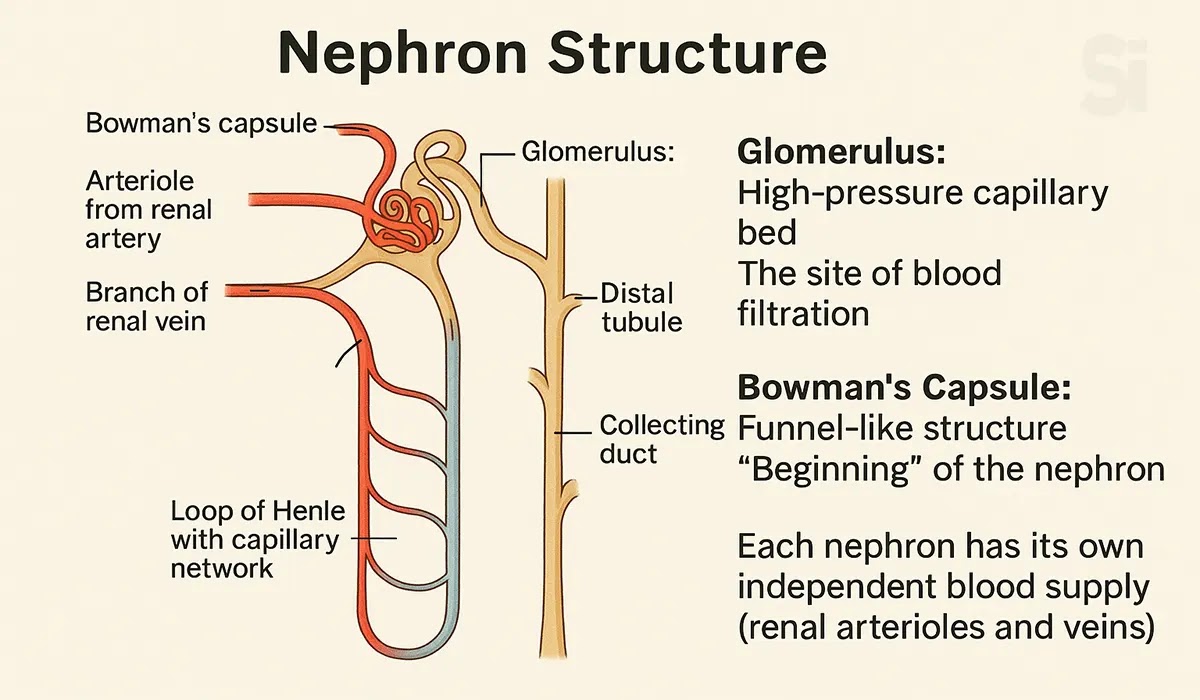
Diagram: Structure of Nephron diagram2
Each of the different components of the nephrons are selectively permeable
to different molecules, and enable the complex regulation of water and ion
concentrations in the body.
Activities in Kidney
* Urine is produced by filtration of: Water, salts, sugar, urea,
creatinine, uric acid Each kidney contains more than
1 million nephrons which are the functional units of the kidneys.
* Blood Flow through the Kidneys:
- Blood enters through the renal artery - arterioles - arteriole - nephron - renal corpuscle-glomerulus.
* The glomerulus filters fluid from the blood and is the first place where
urine is formed in the kidneys.
* Blood flows through the glomerulus at a constant rate.

Diagram: Activities in Kidney diagram
* Each glomerulus is surrounded by a capsule known as Bowman's capsule.
* Blood then passes into the renal tubules where some substances are
reabsorbed and the remaining become urine.
Ureters
A tube approximately 6 to 7 inches long attached to each kidney.

Diagram: Ureters diagram
Made up of three layers of tissue:
- Smooth Muscle
- Fibrous Tissue
- Mucous Layer
Peristalsis, a rhythmic contraction of the ureter smooth muscle which
helps to move the urine into the bladder.
Urinary Bladder
* Hollow, muscular organ that stores urine.
* Sphincter muscles hold the urine in place.

Diagram: Urinary Bladder diagram
* Holds 300 to 400 milliliters of urine before emptying.
* Walls contain epithelial tissue that stretch to allow the bladder to
hold twice its capacity.
* The trigone is a triangular area at the base of the bladder where the
ureters enter and the urethra exits.
Urethra
A tube of smooth muscle with a mucous lining that carries urine from the
bladder to the outside of the body. Excreting urine is called voiding or
micturition.
Male Urethra:
- Approximately 8 Inches Long
-
Passes Through Three Different Regions:
- Prostate Gland
- Membranous Portion
- Penis
Female Urethra:
- Approximately 1.5 inches long.
- Opens through the meatus.
Urine Formation

Diagram: Urine Formation diagram
Terms Used to Describe Difficulties in Urination
| Enuresis: | No urinary output. |
| Dysuria: | Painful urination. |
| Enuresis: | Lack of bladder control. |
| Polyuria: | Excessive urination. |
| Incontinence: | Involuntary discharge of urine or feces. |
| Oliguria: | Scanty urination. |
Urinary System Surgical Terms
- Nephrectomy- removal of a kidney.
- Ureterectomy- removal of a ureter.
- Cystectomy- removal of the bladder.
- Nephrolysis - Removal of an adhesion in the kidney.
- Nephrolithotomy - Removal of a kidney stone.
Surgical repair procedures:
- Pyeloplasty- repair of the renal pelvis.
- Cystoplasty- repair of the bladder.
- Urethroplasty- repair of the urethra.
- Pyeloplasty- repair of the renal pelvis.
- Cystoplasty - repair of the bladder.
- Urethroplasty - repair of the urethra.
- A urostomy is the creation of an artificial opening in the abdomen through which urine exits the body.
- Nephropexy - Surgical fixation of the kidney.
- Nephrorrhaphy - Suturing of a damaged kidney.
Medications used for urinary conditions
| Relieve Pain | (Analgesic) |
| Relieve Spasms | (Antispasmodic) |
| Inhibit the growth of microorganisms | (Antibiotic) |
| Increase urine output | (Diuretic) |
| Decrease urine output | (Antidiuretic) |
Male Urinary System
The male urinary system is made up of the kidneys, ureters, bladder,
and urethra, and it plays a vital role in removing waste and
maintaining fluid balance in the body. The kidneys are located on
either side of the spine, and their main job is to filter the blood,
remove toxins, and regulate electrolytes and water levels.
From the
kidneys, urine travels through the ureters—two thin tubes that
connect each kidney to the bladder. The bladder is a hollow,
muscular organ that stores urine until the body is ready to release
it.
What makes the male urinary system different from the female system
is mainly the urethra. In men, the urethra is much longer—about 8
inches—compared to women. It passes through the prostate gland and
extends through the penis, serving two purposes. First, it allows
urine to leave the body, and second, it functions as a channel for
semen during ejaculation.
The male urethra is divided into different
regions, including the prostatic urethra, the membranous portion,
and the spongy or penile urethra. Each section has its own
importance in the flow of urine and semen.
Because of these differences, men are more likely to face certain
urinary problems, such as prostate enlargement (benign prostatic
hyperplasia), urinary obstruction, kidney stones, and specific types
of infections.
For example, when the prostate gland enlarges, it can
press on the urethra and make it difficult for urine to pass,
leading to weak flow, frequent urination, or incomplete emptying of
the bladder.
Female Urinary System
The female urinary system is made up of the kidneys, ureters,
bladder, and urethra, all working together to remove waste and
maintain fluid balance in the body. The kidneys filter the blood and
produce urine, which then travels through the ureters to reach the
bladder. The bladder acts as a storage organ, holding urine until
the body is ready for elimination.
A key difference in the female system is the urethra, which is much
shorter than in males—about 1.5 inches in length. The urethra opens
through a small external opening called the meatus, located above
the vaginal opening. Because of this shorter structure, bacteria can
reach the bladder more easily, making urinary tract infections more
common among women.
The female urinary system is closely related to the reproductive
system because of their anatomical proximity. This connection can
sometimes influence urinary health, especially during pregnancy or
other hormonal changes, when pressure on the bladder may increase
the frequency of urination.
AMS 800 Urinary Control System
The AMS 800 urinary control system is a medical device designed to
manage male stress urinary incontinence, which often occurs after
prostate surgery. This system functions as an artificial urinary
sphincter. It consists of three main components: a fluid-filled cuff
placed around the urethra, a small pump implanted inside the
scrotum, and a pressure-regulating balloon positioned in the
abdomen.
The cuff remains inflated to keep the urethra closed and prevent the
leakage of urine. When the patient wants to urinate, the pump is
squeezed, transferring fluid from the cuff to the balloon. This
temporarily opens the urethra and allows urine to pass. After a few
minutes, the cuff automatically refills with fluid, closing the
urethra again and restoring continence.
The AMS 800 system has been widely used for decades and is
considered the gold standard for treating severe male stress
incontinence. It helps patients regain bladder control, reduces
leakage, and significantly improves quality of life.
FAQs
Q) What is the urinary system and why is it important for SRs to learn?
A) The urinary system removes waste and excess fluid from the body. For SRs,
knowing this system helps explain how certain drugs affect the kidneys and
urine flow.
Q) Which organs are included in the human urinary system?
A) The urinary system includes the kidneys, ureters, bladder and urethra.
Each plays a role in filtering blood and passing urine from the body.
Q) How does understanding the urinary system help in pharmaceutical sales?
A) It helps Pharmaceutical Sales Representative communicate how medicines
work, especially those used for kidney diseases, urinary infections, or
diuretics, with clarity to doctors.
Q) What Does Blood pH Mean?
A) Blood pH measures how acidic or alkaline your blood is. The normal range
is 7.35 to 7.45 (slightly alkaline). Below 7.35 is called acidosis (too
acidic), and above 7.45 is alkalosis (too alkaline). Maintaining a balanced
pH is vital for healthy body function. Even small changes can affect organs
and metabolism.
Conclusion
Gaining a clear understanding of The Human Urinary System and Its Functions is a valuable step in your role as a Pharmaceutical Sales Representative. When you know how urine is formed and passes through the kidneys, ureters, bladder, and urethra, you can discuss kidney-related medicines with greater confidence. This knowledge not only improves your communication but also helps you build trust with healthcare providers, supporting you throughout your pharmaceutical career.

Sarwar Hossain ✅
I am a travel enthusiast and sports-loving person. Education: BBA & MBA in Accounting.